In this article


Cost of a Friday Night
New survey reveals Brits’ takeaway spending habits and preferences, as well as the true cost of a Friday night across the nation.



In the UK, two-fifths (40%) of Brits order takeaway one to two times a month. They are convenient: they save time after a long day at work, make an easy Friday night treat to kick off the weekend, and with countless platforms now available, there’s a cuisine to satisfy every palate.
Takeaways are usually seen as an occasional treat, but the costs can soon add up and become a noticeable part of household spending. That’s especially true at the moment, with the rising cost of living continuing to affect everyday budgets across the UK.
Our latest research shows that around two-fifths (39%) of UK adults say they’re spending more on takeaways each month than they were two years ago. As a result, over half (59%) say they’re ordering less often, as many households look to cut back on these small “treat” spends when money feels tighter.
To explore this further, we surveyed 2,000 UK adults to uncover their habits, preferences, and the financial impact of regular takeaway consumption. We also analysed the average cost of the UK’s most popular takeaway options in cities across the country to reveal the cost of a typical Friday night takeaway in the UK.
How much Brits are spending on takeaways
On average, UK adults order a takeaway around twice a month, although for more than one in five (21%) this rises to around three to four times a week. Our survey found that UK adults spend an average of £27 per order, which works out at around £54 per month for those ordering twice a month, and roughly £108 per month for those ordering weekly (based on the same average spend per order).
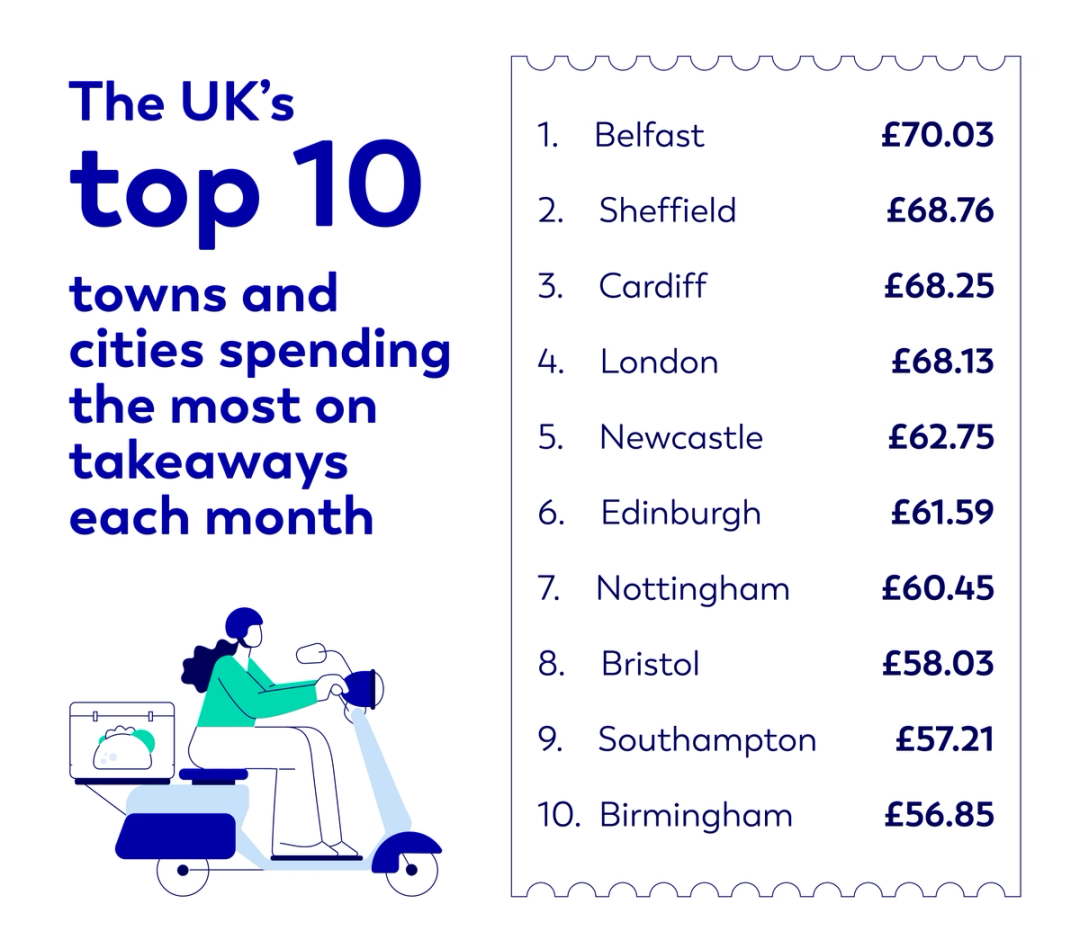
When it comes to cities, Belfast residents are the biggest spenders, paying an average of £70.03 a month on takeaways, more than they spend on their commuting and travel costs (£60.24), streaming subscriptions (£43.77), or phone bills (£36.01).
People from Sheffield follow closely with £68.76, while Cardiff rounds out the top three at £68.25.
Spending also differs by age. Our survey found that Gen Z are the biggest spenders overall, at £77.57 per month, followed by Millennials, who spend an average of £66.28 each month on takeaways.
This drops significantly for older generations: Gen X spend £49.85 on average per month on takeaways, while Baby Boomers spend even less, at £38.83, less than half of what Millennials spend.
This points to a clear pattern: younger generations are ordering and spending more on takeout. This could reflect a wider shift in attitudes towards cooking and work, with younger people more likely to juggle busier schedules and longer working hours, something takeaways can help manage. Younger generations may also be more at ease with technology, and delivery platforms are now the main means of ordering takeaways.
How has spending on takeaways changed?
Over the past couple of years, spending habits have shifted quite a bit. Our survey found that nearly two-fifths (39%) of UK adults say their monthly takeaway spending has increased, with almost two-thirds of these pointing to the rising cost of living as the main reason. Nearly a quarter (24%) specifically cite higher food prices as a key concern, highlighting the wider impact of ongoing cost of living pressures.
Most age groups surveyed agree that the cost of living is the main driver, but for 18 to 24-year-olds, lifestyle changes are the leading reason for a quarter of them (25%), rising to 29% among students.
This is often a transitional period for many in this group, from starting to finishing university or moving to a new city for a first job. During this time, social dynamics often shift, as moving away from home brings greater independence alongside a busier and often more expensive social life. Takeaways are also seen as a convenient, time-saving option, helping to free up time for studying, work, or socialising.
Ultimately, these shifts can have an impact on how much people spend on takeaways.
As a result, non-essential spending, including takeaways, is often the first to go when budgets tighten. Over half (59%) of UK adults say they’re ordering less, as are nearly half of residents in every city surveyed. Plymouth residents are the most impacted, with over three-quarters (77%) cutting back on takeaway spend.
How much Brits are spending on takeaways vs essential costs
While food shopping, energy bills, and commuting are the biggest monthly expenses for UK adults overall, our survey found a number of cities where takeaway spending actually exceeds commuting costs. In Belfast (£70.03 vs £60.24), Edinburgh (£61.59 vs £57.06), Newcastle (£62.75 vs £57.22), Nottingham (£60.45 vs £58.53), and Sheffield (£68.76 vs £55.21), people are spending more each month on takeaways than on travel to work.
Additionally, takeaway spending looks quite different depending on household size. Single-person households spend £44.05 a month on average, compared with £63.52 in households of three. But the picture shifts when you look per head, with larger households spending just £21 per person, suggesting shared orders can bring the cost down.
The UK’s favourite takeaway options
There are a wide range of takeaway options available, but which ones do Brits prefer most? As part of our survey, we asked UK adults about their favourite types of takeaway meals to reveal the nation’s top 10 choices.
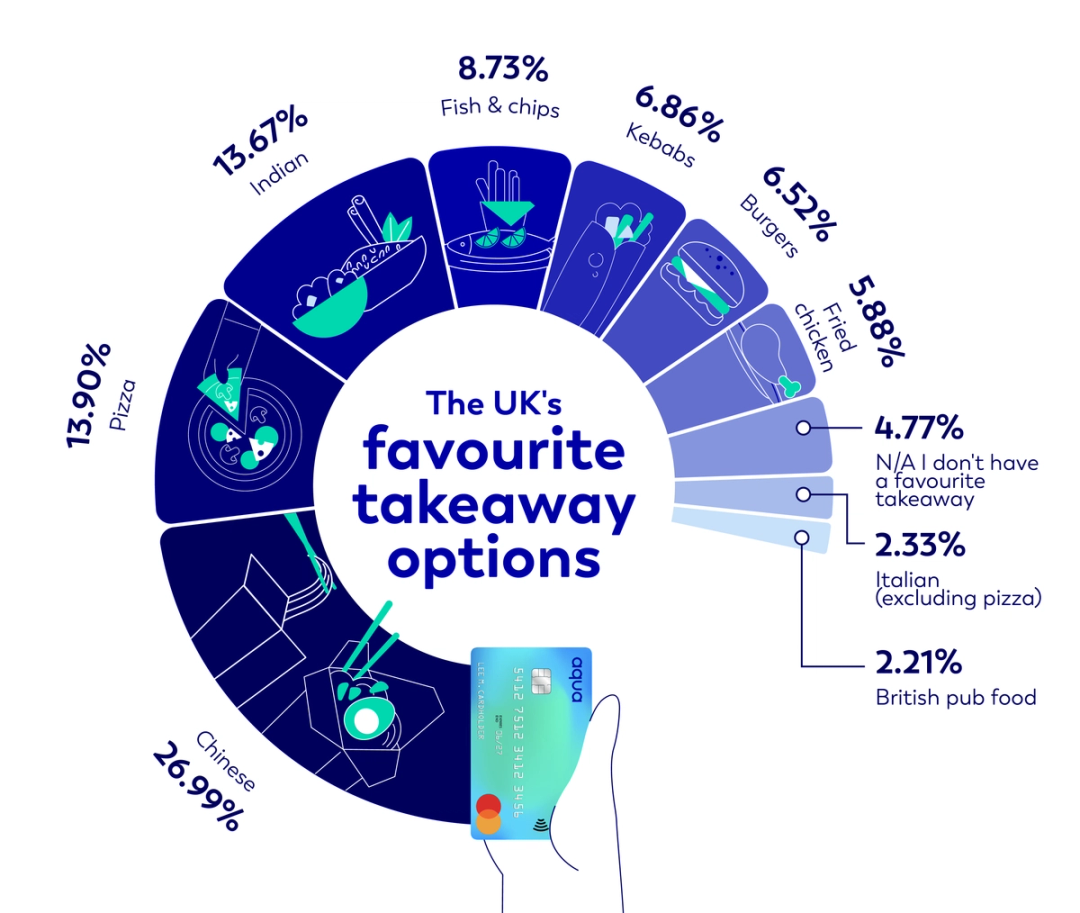
People in the UK agree on at least one thing: they love Chinese takeaway. In fact, our data reveals that over a quarter (26.99%) of UK adults name it as their favourite. Additionally, every single city we surveyed also named Chinese as their favourite takeaway option, except for Brighton, where pizza takes the top spot, preferred by nearly one in five people (19%).
Pizza is also the second most popular overall, with 13.90% naming it as their favourite. Close behind is an Indian takeaway, favoured by 13.67%, followed by the classic fish and chips (8.73%).
The most and least affordable cities in the UK for a takeaway
Takeaway prices can vary significantly depending on where you live. To explore this, we analysed the cost of three of the UK’s favourite takeaway options, and their most popular dishes: a margherita pizza, chicken chow mein, and chicken tikka masala, across the top five highest-rated takeaway restaurants in towns and cities across the UK. This allowed us to identify where takeaways are most and least affordable.
The most and least affordable cities in the UK for a takeaway pizza
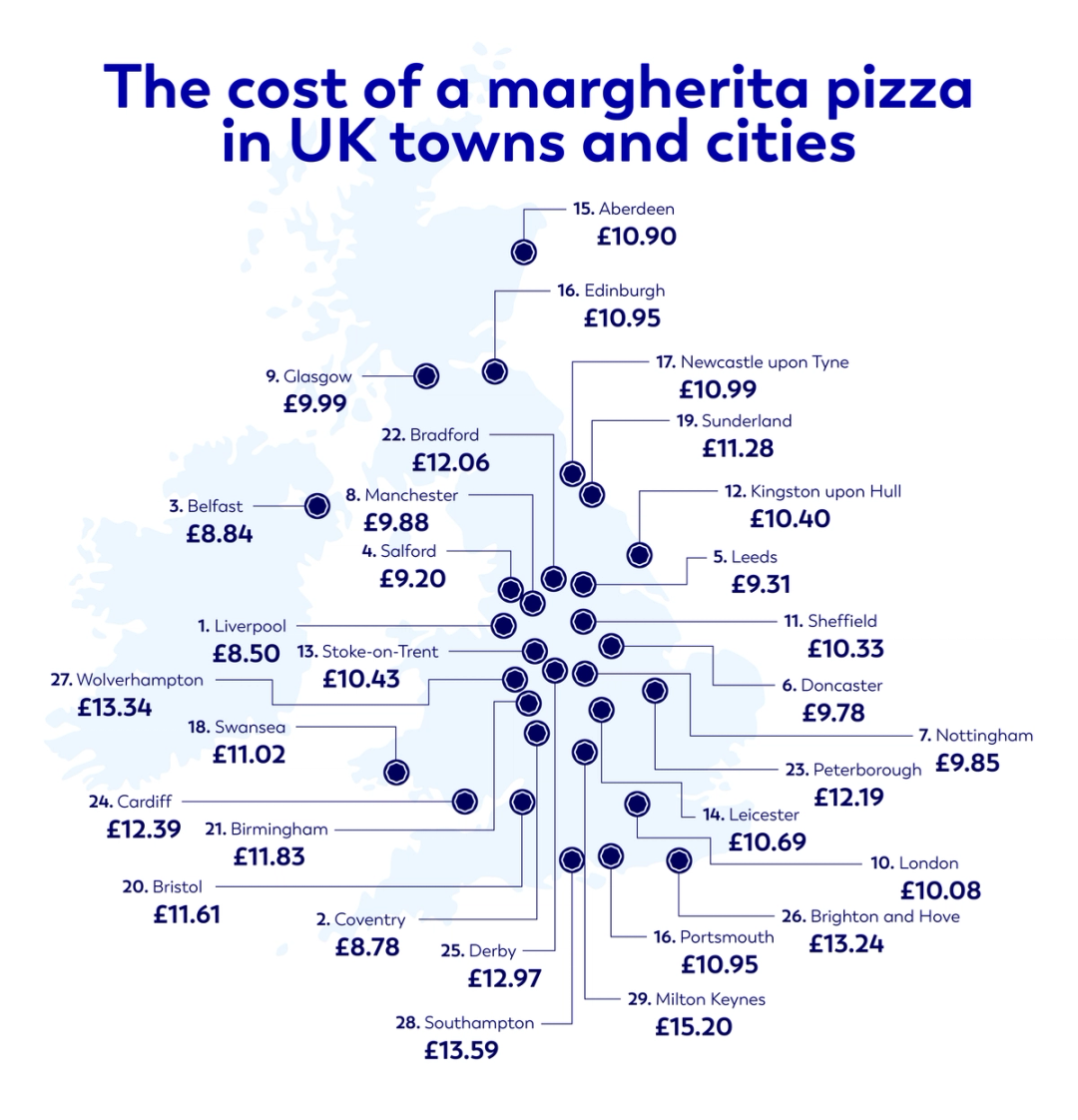
Our analysis reveals that most of the cities in the top 10 offer a margherita for less than £10 on average.
Liverpool takes the top spot as the most affordable city in the UK for a takeaway pizza, at £8.50 on average for a margherita. There, people can enjoy pizza from both independent and chain restaurants on a Friday night, whether with their family, friends, or as a solo treat to start off the weekend.
Coventry takes second place, offering a pizza for as little as £8.78, followed closely by Belfast with a pizza costing £8.84 on average. On the other hand, some cities in the UK are on the pricier side. Milton Keynes is the most expensive city in the UK for a pizza, at £15.20 each on average.
In the south of England, Southampton takes second place, with a pizza costing on average £13.59, while Wolverhampton completes the top three at £13.34.
The most and least affordable cities in the UK for a Chinese takeaway
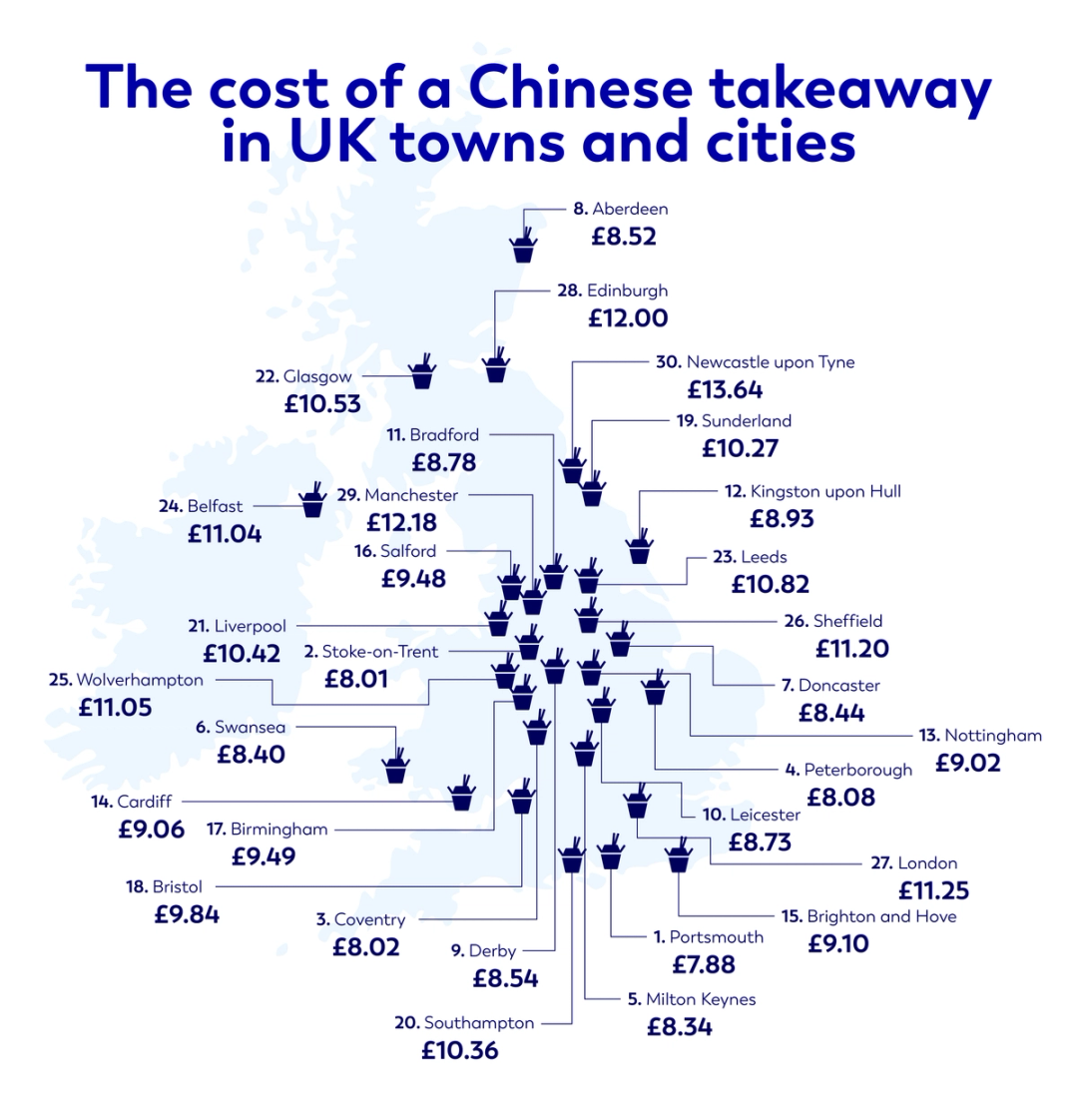
When it comes to Chinese takeaway, Portsmouth offers the cheapest option in the UK, at £7.88 on average for a chicken chow mein. Stoke-on-Trent follows closely at £8.01 on average, while Coventry rounds off the top three at £8.02, nearly identical to Stoke-on-Trent.
On the other hand, Newcastle is the most expensive UK city for a Chinese takeaway. There, a chicken chow averages £13.64, nearly six pounds more than in Portsmouth. Manchester takes the second spot, with people there paying £12.18 on average for a Chinese takeaway on a Friday night, followed by Edinburgh at £12.
The most and least affordable cities in the UK for an Indian takeaway
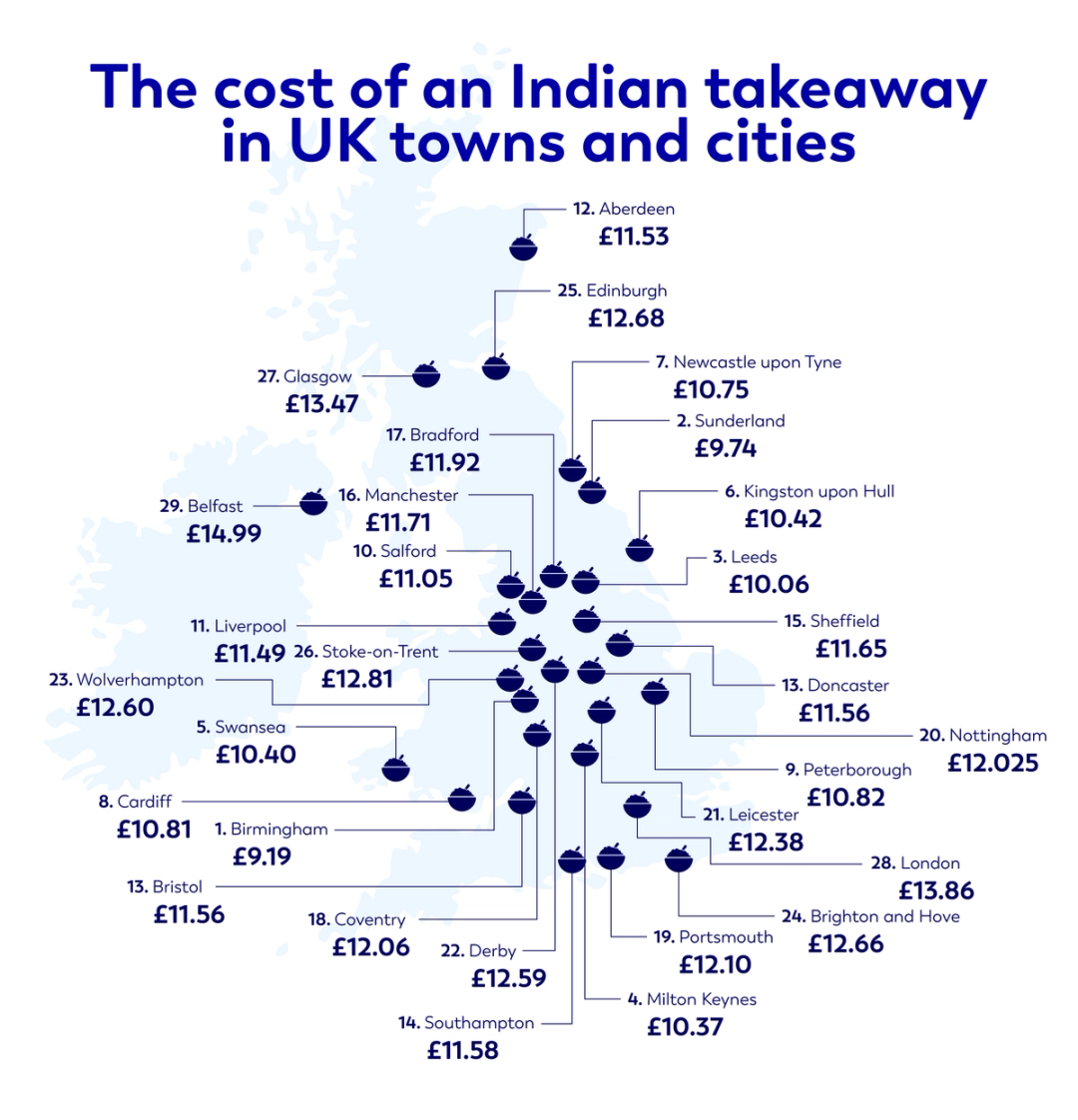
Indian takeaways are also hugely popular in the UK, with over seven million UK adults saying it’s their favourite, and Birmingham is the cheapest city across the country for this Friday night staple. There, Brummies and visitors alike can expect to pay under £10 (£9.19) for a chicken tikka masala.
People in Sunderland pay an average of £9.74 for an Indian takeaway, while those in Leeds pay £10.06 on average. Both prices remain close to the £10 mark, with Sunderland falling just below it and Leeds slightly above.
On the other hand, Belfast takes the top spot for the most expensive city in the UK for an Indian takeaway, where a chicken tikka masala costs nearly £15 (£14.99) on average, almost six pounds more than in Birmingham. Interestingly, while London is among the 10 cheapest cities for a pizza, the capital ranks here as the second most expensive for an Indian takeaway, costing £13.86 on average. Glasgow follows in third place, at £13.47.
Expert tips for smarter takeaway spending habits
It’s clear that Brits love a takeaway, with the average adult spending around £54 a month. However, spending habits across the UK have shifted in recent years, largely driven by rising cost-of-living pressures.
With over half of Brits (59%) saying they are now spending less on takeaways, Scott Yule, Commercial Strategy Director at Aqua, shares tips on how to stretch your budget further so you can still enjoy an occasional treat without giving up too much of the experience.
1. Set a monthly “treat” budget
“As much as many would do for holidays or other bigger expenses, allocate a fixed monthly amount for takeaways, rather than ordering spontaneously,” says Scott. “This helps ensure spending stays within a wider household budget and prevents small, frequent purchases from adding up unnoticed.”
2. Use loyalty schemes and discount platforms
“Taking the time to check deals will give you the best chances to save money, and those few extra pounds can be spent elsewhere or added to a savings account. Many restaurants and delivery apps offer loyalty points, voucher codes or first-order discounts, and checking for offers before ordering can meaningfully reduce the cost over time.”
3. Compare delivery fees and minimum spend thresholds
“Today, many platforms often offer similar options - even the same restaurants - and the same meal can vary in price from one to another, depending on delivery charges, surge pricing and minimum order requirements. Taking the time to compare before ordering can help save money. Additionally, opting for collection where possible reduces overall cost.”
4. Swap frequency for planning
“Planning takeaway nights in advance (rather than ordering impulsively) can naturally reduce frequency. Whether it’s a date night in, a solo Friday dinner, or a meal with friends and family, having it planned can help cut back on frequency and the expenses that come with it - and it gives you something to look forward to. Some households even find it helpful to designate one planned takeaway night per week or fortnight.”
5. Consider “fakeaway” alternatives
“‘Fakeaways’ - homemade versions of popular takeaway dishes - have become increasingly popular in the UK, driven by rising living costs. Recreating popular dishes at home, such as curry or pizza, can cost a fraction of a takeaway while still delivering a similar experience and enjoyment.”
Methodology
We surveyed 2,000 UK adults in June 2026 to understand their spending habits and preferences when it comes to takeaways.
We also revealed the most and least affordable cities for a takeaway in each UK city, looking at the cost of a pizza, a Chinese, and an Indian. To do so, we analysed the cost of a margherita, a chicken chow mein/vegan chicken chow mein, and a chicken tikka masala, using Uber Eats. We averaged the cost of each dish for the top five best-rated restaurants open on a Friday at 7 pm in each city to get a final result.
Data is correct as of June 2026.
Failure to make payments on time or to stay within your credit limit means that you will pay additional charges and may make obtaining credit in the future more expensive and difficult.
Contributors


You might also like
Slide 1 of 3
The best staycation destinations in the UK
New research by experts at credit card brand Aqua reveals which UK locations are the best, and most affordable, for...


Summer Destinations: UK vs Europe
Discover where your money stretches further for summer holidays in 2026.

The Great British Beer Garden
Our recent study reveals the best cities across the UK for a beer garden trip in 2026.
The smart way to build better credit
Aqua is the credit card that gives you the power to improve your credit score