Payday to Payday
Discover how long Brits’ money lasts between paydays, from saving habits and credit use to financial pressures, plus five practical tips for managing your money.



Previous research has found that 15% of Brits run out of money before their January payday. But what happens during the rest of the year? How long do people’s pay cheques typically last, and how are households managing their finances from month to month?
To find out, we surveyed 2,000 UK adults to gain a clearer picture of their monthly financial habits and the realities of day-to-day money management. We looked at everything from whether people are able to save each month, and how much they put aside, to how often they rely on credit cards to manage their cash flow and when during the month their finances begin to feel stretched.
The findings offer a snapshot of how Brits are balancing spending, saving and credit throughout the year, highlighting some of the financial pressures facing households today. Nearly three in ten Brits (29.7%) say they don’t save any money each month, while those who do save put aside an average of £152 per month.
With almost a quarter (23%) of Brits also saying they worry every day about having enough money to last until payday, managing monthly finances can clearly be a challenge. Alongside the findings, we’ve shared some helpful tips and advice to help Brits make the most of their income, manage their spending and reduce some of the financial stress that can come with making it to the next payday
How long Brits pay cheques last
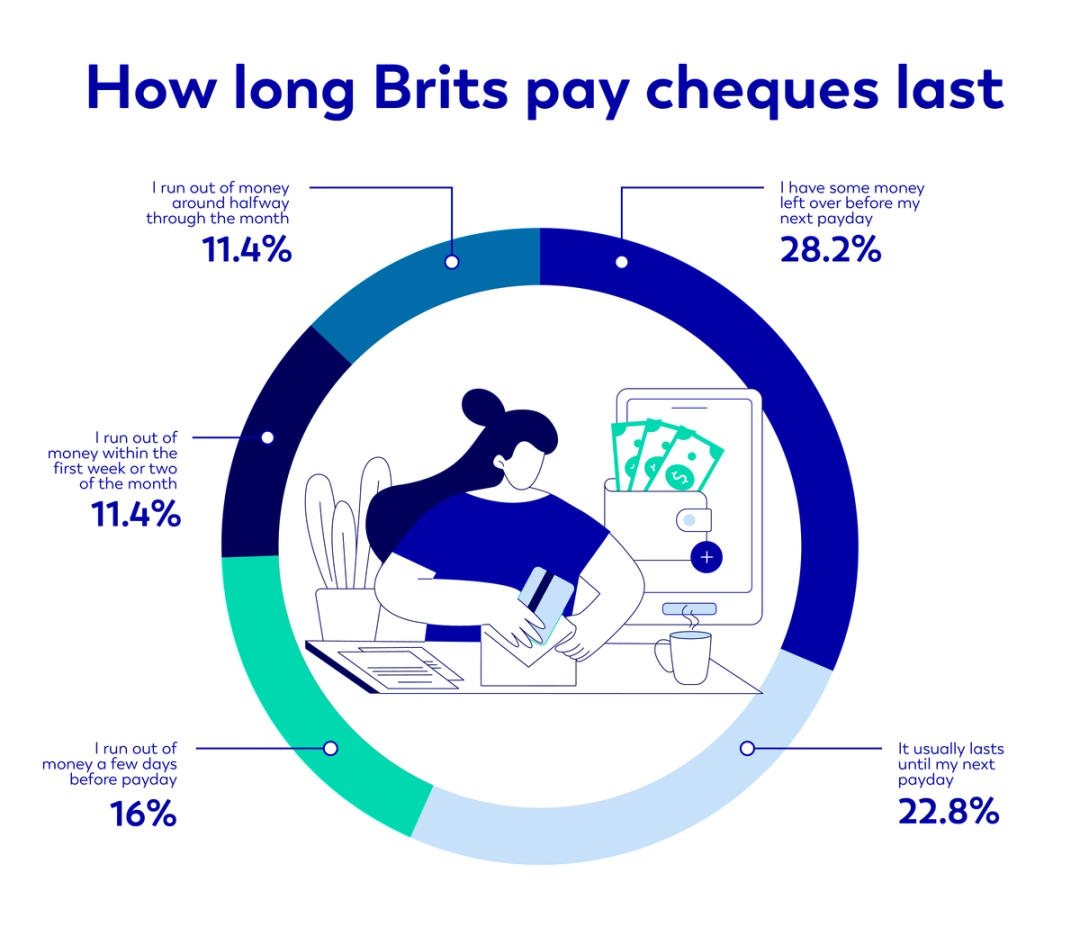
For many Brits, making a monthly income stretch all the way from one payday to the next is not always straightforward. Our research found that just over a quarter of Brits (28.2%) typically have some money left over by the time their next payday arrives, while a further 22.8% say their income usually lasts exactly until they are paid again.
However, a significant proportion find themselves running out of money before that point. Around one in six (16%) say they typically run out a few days before payday, while 11.4% run out within the first week or two of the month. Combined, this means almost two in five Brits (38.8%) typically run out of money at some point before their next payday.
The findings also reveal some notable differences between generations. Those aged 35 to 44 are among the most likely to say they run out of money a few days before payday, at 20.2%. Meanwhile, almost one in six 18 to 24 year olds (15.5%) say they run out within the first week or two of the month.
At the other end of the scale, those aged 55 and over are the most likely to have money remaining, with almost a third (32.1%) saying they typically have some money left before their next payday.
When does the payday pressure start?
Running out of money is only one part of the picture. Even among those who make their income last throughout the month, the prospect of reaching the next payday can create financial concern.
Almost a quarter of Brits (23%) say they worry every day about having enough money to last until payday, showing that managing monthly finances can be a source of concern for a sizable proportion of the UK population.
Feeling financially stretched does not necessarily mean somebody has completely run out of money. As bills, essential spending and other costs accumulate throughout the month, the amount available for everything else can gradually become smaller. This can make understanding where money is going particularly important. Keeping track of both regular commitments and everyday spending can provide a clearer view of what is available for the remainder of the month and help identify where costs may be adding up.
Brits aged 18 to 24 worry most frequently about having enough money to last until their next payday, with those who experience this concern doing so an average of 14 times a month, equivalent to around 3.5 times a week.
However, it is those aged 45 to 54 who are most likely to feel this pressure on a daily basis. More than a quarter (27.9%) of those in this age group who worry about making their money last say they do so every day, the highest proportion of any age group analysed.
How do Brits manage when money runs out before payday?
When finances become tighter during the month, people may take different approaches to managing their spending. For some, this includes using a credit card for purchases, with 27.9% of Brits stating they use a credit card to cover expenses if they run out of money before payday.
However, there is an important distinction between using a credit card for planned spending and relying on borrowing to meet essential living costs. Our research found that more than half of Brits (52%) use a credit card at least once a month to cover essentials, highlighting how borrowing forms part of monthly money management for many households. Among those who use credit in this way, more than a third (34.8%) do so at least once a week.
Credit card use is also notably higher among younger adults. Those aged 18 to 24 use a credit card an average of 13 times a month, almost twice as often as 35 to 44 year olds, who average seven uses per month, and nearly three times as often as those aged 45 and over, who use one an average of five times a month.
This could reflect the greater financial pressures facing some younger adults, who may have lower incomes, less established savings and a smaller financial buffer to fall back on when unexpected or essential costs arise.
Any money spent on a credit card is borrowed and needs to be repaid. Depending on how the account is managed and the terms of the card, interest and charges may also apply. Keeping track of credit spending alongside money leaving a current account can therefore help provide a more complete picture of monthly outgoings.
If someone is regularly turning to borrowing because they cannot afford essential costs or existing repayments, taking on further credit may not be appropriate and seeking support could be a more suitable next step.
The additional income and financial support Brits rely on to manage their finances
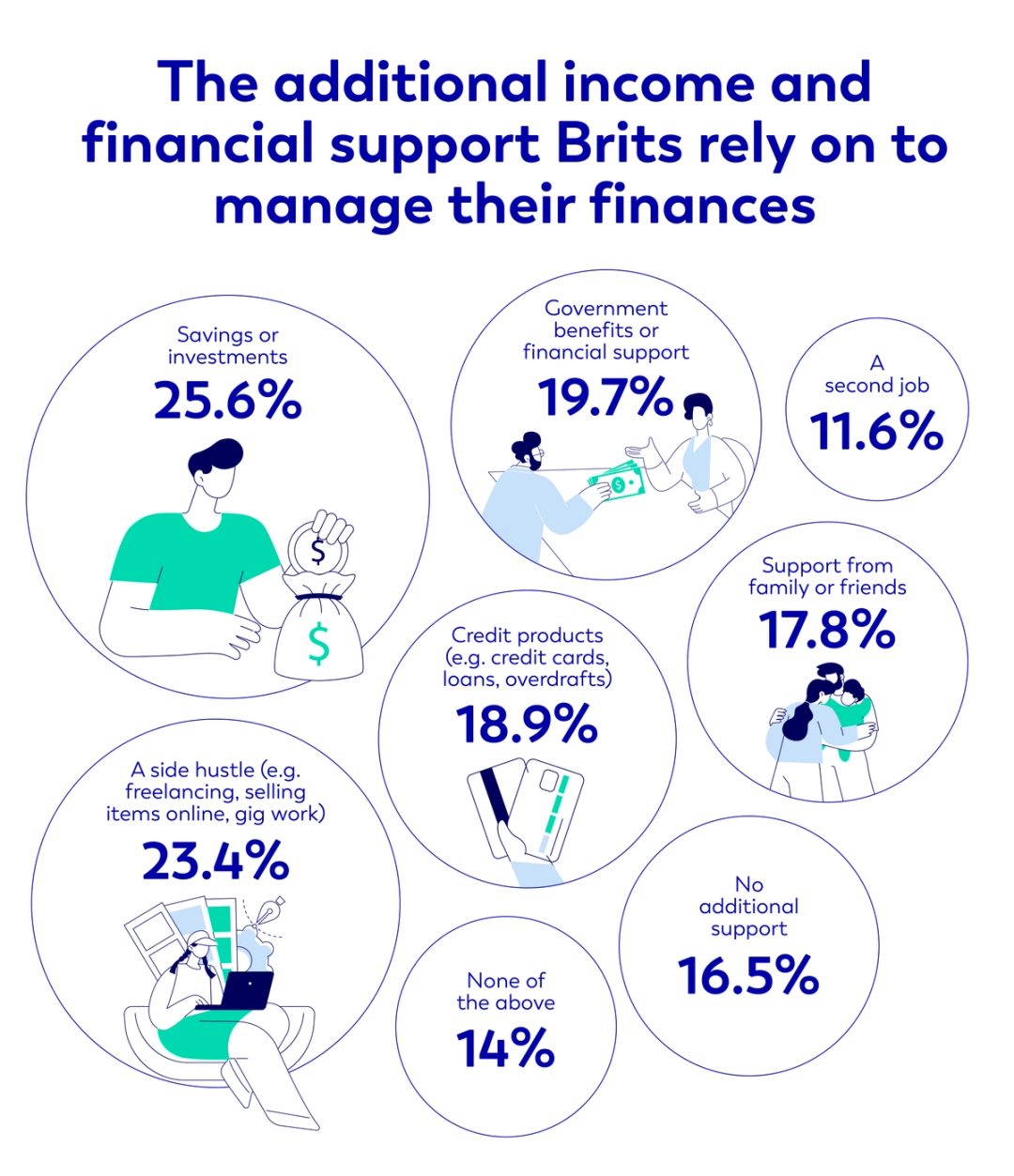
Looking at the UK as a whole, savings and investments are the most common additional resource Brits turn to when managing their finances, with just over a quarter (25.6%) of respondents saying they rely on money they have previously put aside.
Side hustles follow closely behind, with almost a quarter of Brits (23.4%) supplementing their finances through activities such as freelancing, selling items online or gig work. A further one in five (19.7%) rely on government benefits or financial support.
Borrowing also plays a role in some households' finances. Almost one in five Brits (18.9%) say they rely on credit products, including credit cards, loans or overdrafts, while 17.8% receive financial support from family or friends. Having an additional job is less common, although more than one in ten respondents (11.6%) say they rely on a second job to help manage their finances.
Income has a particularly strong relationship with the type of financial support people use. Among those earning between £65,001 and £75,000, 43.9% say they rely on savings or investments to help manage their finances, compared with just 19.3% of those earning £15,000 or less.
Side hustles are also relatively common among higher earners. More than two in five people earning between £65,001 and £75,000 (45.5%) say they rely on one, compared with 18.1% of those earning £15,000 or less.
Nearly three in ten Brits save nothing each month
Making it through to the next payday can be a challenge, but building up money for the future can present another. Our research found that almost three in ten Brits (29.7%) do not save any money during a typical month, suggesting that a sizable proportion of people may have little room within their monthly finances to put money aside.
Among those who are able to save, the average amount put aside is £152 a month. However, the amount people can afford to save varies considerably depending on their individual circumstances, meaning the national average may not be realistic for every household.
The research also reveals a noticeable difference between age groups. Brits aged 25 to 34 put away the most, saving an average of £202 each month. In comparison, those aged 45 to 54 save the least, at an average of £113 a month, £89 less than their younger counterparts.
Which UK cities are the biggest savers?
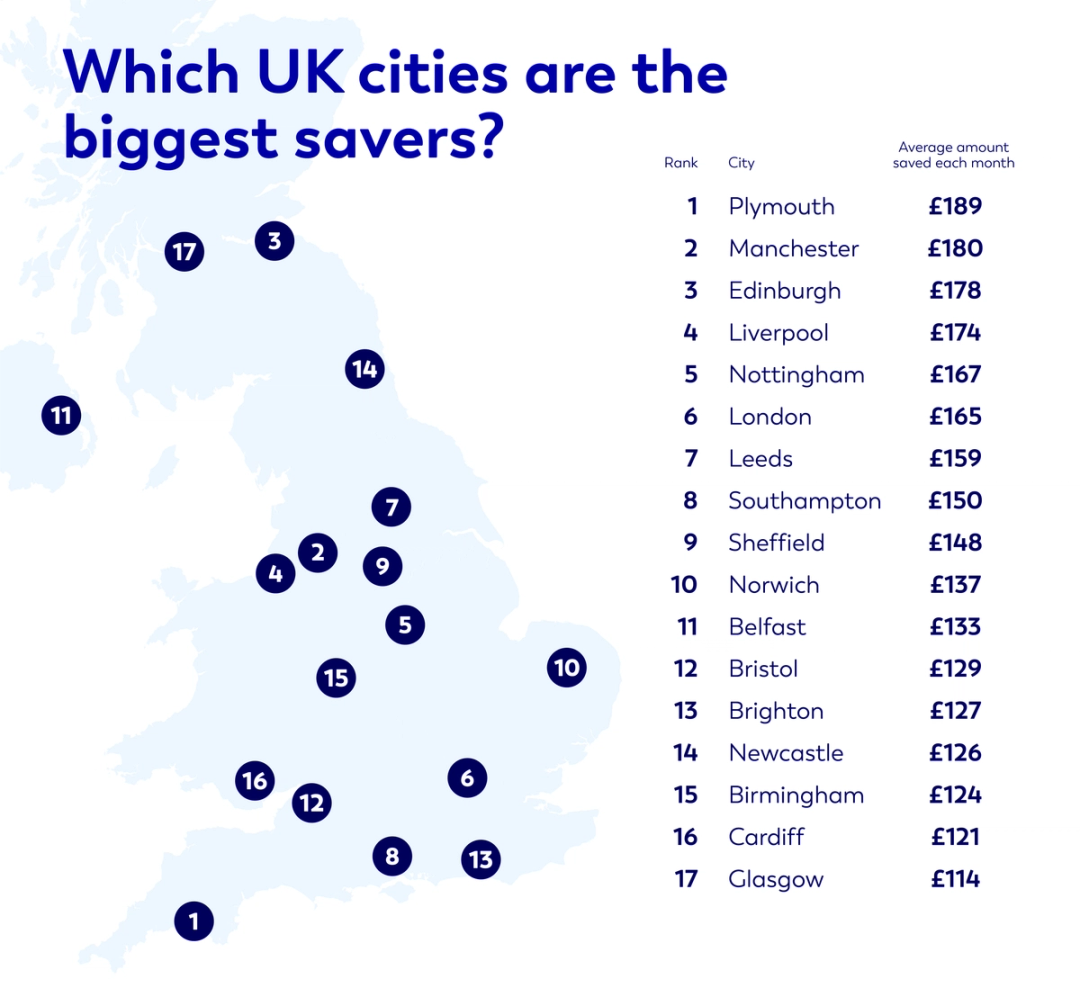
The data also reveals how much people across different UK cities put aside each month. Among those surveyed who save, Plymouth comes out on top, with residents saving an average of £189 per month. Manchester follows closely behind at £180, while Edinburgh completes the top three at £178.
At the other end of the table, respondents in Glasgow save the least on average, putting aside £114 each month. This is £75 less than those in Plymouth. Cardiff and Birmingham also rank towards the bottom, with average monthly savings of £121 and £124 respectively.
Interestingly, London sits in the middle of the ranking despite its higher cost of living, with respondents in the capital saving an average of £165 per month.
The table below shows the average amount saved each month by respondents who save across the UK cities analysed.
Having savings available can provide a financial buffer when unexpected expenses arise, but there is no single amount that everybody should be putting away each month. What is manageable will depend on income, essential expenditure and individual circumstances.
The average Brit says they need 52% more annual income to live comfortably
For many Brits, the amount they believe they need to live comfortably sits well above what they currently earn. On average, respondents estimate that someone in their circumstances would need an annual income of £49,599 to feel financially comfortable.
Perceptions of what constitutes a comfortable income vary considerably depending on age, location, household size and existing earnings, suggesting that there is no single salary that feels sufficient for everyone.
Brits aged 35 to 44 have the highest expectations when it comes to the income needed for a comfortable lifestyle, estimating they would need £59,455 a year on average.
This is closely followed by 25 to 34 year olds, who put the figure at £58,138. In comparison, those aged 55 and over estimate they would need considerably less, at £42,993 a year, around £16,500 below the figure given by 35to 44 year olds.
The difference may reflect the varying financial commitments people face at different stages of life, with some working age households potentially balancing costs such as housing, childcare and other family expenses. However, the survey does not establish the reasons behind these differences.
Men also estimate they would need slightly more than women to live comfortably, at £50,971 compared with £48,244.
Five ways to make your money easier to manage between paydays
While everyone's financial circumstances are different, having a clearer picture of what is coming in and going out each month can make it easier to manage the period between paydays. Scott Yule, Commercial Strategy Director at Aqua shares his tips for finding ways to manage your finances more effectively between paydays
1. Start with your essential monthly costs
Begin by identifying the expenses that need to be paid each month, such as housing costs, household bills, food and transport. Separating these from more flexible spending can give you a clearer idea of how much money is available once essential commitments have been accounted for.
2. Consider breaking your available spending money into weekly amounts
A monthly budget can feel very different immediately after payday compared with the final week of the month. Once essential expenses have been accounted for, dividing the remaining amount across the weeks ahead can make it easier to keep track of how much is available.
3. Keep an eye on smaller and recurring payments
Individual purchases and subscriptions may not appear significant in isolation, but they can add up over the course of a month. Regularly reviewing bank statements and recurring payments can help identify spending that may have been overlooked.
4. Keep track of credit spending too
Paying by credit card can make it less immediately obvious how much has been spent because the money does not leave your current account at the point of purchase. Checking your credit card balance regularly and considering it alongside your other spending can give you a more complete view of your finances.
Remember that a credit card is a form of borrowing. Interest or charges may apply depending on the card, the type of transaction and how the balance is repaid.
5. Build a financial buffer where you can
Our research shows that not everybody is in a position to save each month. However, where circumstances allow, regularly putting aside an affordable amount can gradually create a buffer for unexpected expenses.
Rather than focusing on a particular savings target, consider an amount that is realistic alongside your essential costs and other financial commitments.
What to do if you regularly run out of money before payday
Occasionally having a more expensive month is different from consistently being unable to afford essential costs or meet existing financial commitments.
If you regularly find yourself running out of money well before payday, reviewing your income and expenditure can be a useful first step. Looking at bank statements, bills, subscriptions and existing borrowing can help provide a clearer picture of where your money is going and whether there are costs that can be reduced.
If you have existing credit commitments and think you may struggle to make a payment, contacting your lender as early as possible can also be important. They may be able to explain the support available based on your circumstances.
Taking on additional borrowing is not necessarily an appropriate solution to ongoing financial difficulty. Free and impartial money and debt guidance is also available for people who are struggling with their finances.
Methodology
The research was conducted among 2,000 nationally representative UK adults aged 18 and over between 30 July and 3 August 2026. The percentages have been rounded where appropriate, so totals may not always equal 100%.
[1] The average annual income of respondents was calculated as £32,559, while the average amount respondents said someone in their circumstances would need to earn per year to live comfortably was £49,599.
Based on these mean values, respondents believe they would need an additional £17,040 in annual income, equivalent to approximately 52% more than the average respondent income, to live comfortably.
Contributors


You might also like
Slide 1 of 3
How to budget effectively
Find out how to keep on top of your finances and become a budgeting pro.


Advantages of using a credit card
From spreading costs to building credit history, learn the benefits of credit cards when used responsibly.


How to budget for a holiday
Find out how to budget and save for the holiday of your dreams and how Aqua can help.
The smart way to build better credit
Aqua is the credit card that gives you the power to improve your credit score